Here’s something parents don’t expect: the best time to start chores is when your child is least capable of doing them well.
A 4-year-old who “helps” fold laundry is mostly creating new wrinkles. A 5-year-old making their bed is producing something that vaguely resembles a made bed. A 6-year-old who feeds the dog might spill half the kibble on the way to the bowl.
None of that matters. What matters with chores for 4 to 6 year olds is that they’re doing it — and that they’re building the identity of someone who contributes. That identity, cultivated early, is one of the most valuable things you can give your child.
This guide covers 15 realistic chores for ages 4–6, with brief notes on how to teach each one and what to do when it (inevitably) doesn’t go perfectly.
What to Expect from Kids Ages 4–6
Before diving into the list, a quick developmental reality check:
- Attention span: 5–15 minutes for a structured task. Keep chores short.
- Motor skills: Developing rapidly but still imprecise. Spills, drops, and rough results are normal.
- Motivation: High enthusiasm for helping, low tolerance for repetition. Novelty helps.
- Memory: Visual cues and routine matter more than verbal reminders. A chore chart with pictures beats a daily ask.
The goal at this age is not a clean house. It’s building the habit, the routine, and the self-image of a child who contributes to the family. Perfection is not on the table yet.
| 💡 The Key Mindset Shift for This Age You are not teaching chores. You are building a person.Prioritize participation over performance — every single time.Praise the effort specifically: “I love how you put every toy back in the box.”Expect to redo work quietly, without commentary, after they go to bed. |
15 Age-Appropriate Chores for 4 to 6 Year Old Kids
1. Put Toys Away After Play
The foundational chore. Every toy, book, and game has a home. After play, it goes back there. Keep toy storage low to the ground, clearly labeled (pictures help), and simple — big bins are easier than sorted shelves.
How to teach it: Do it together the first 5–10 times. Make it a song, a race, or a game. Say “toys go to sleep in their homes” if it helps.
2. Make Their Bed
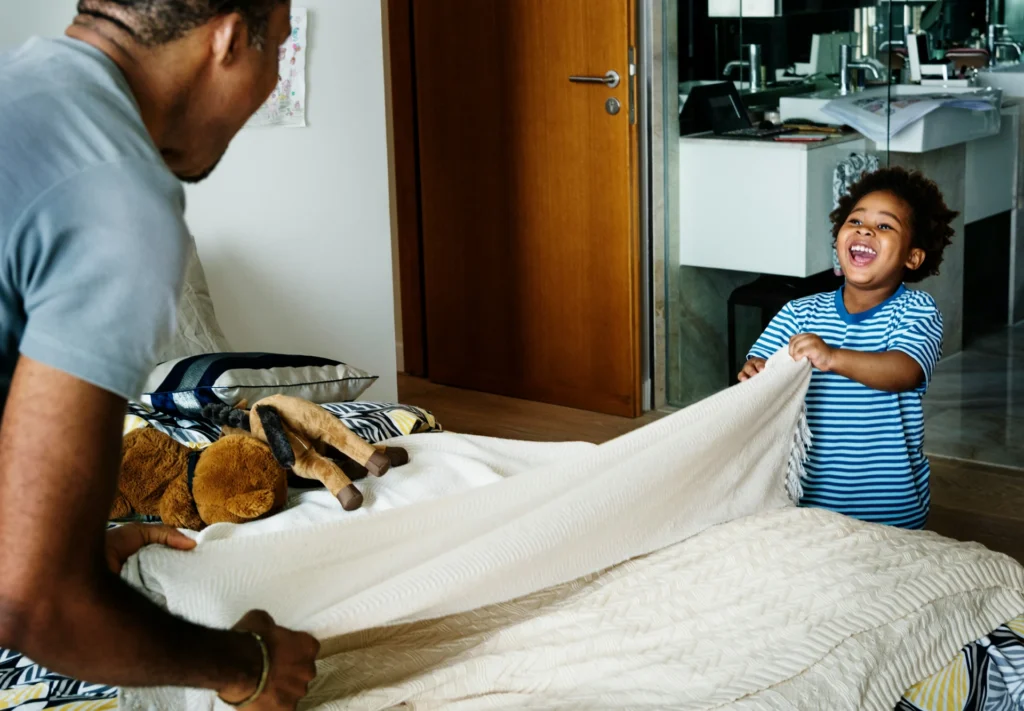
The standard for a 4-year-old is: blanket pulled up, pillow on top. That’s it. Don’t expect military corners. The habit of making the bed is the goal, not the quality.
How to teach it: Stand beside them and guide their hands the first time. Let them “finish” even if you’ve done most of it. Gradually pull back.
3. Clear Their Place at the Table
After meals, they carry their plate to the counter or sink. Use unbreakable dishes. Even better: a low counter spot they can reach without stretching.
How to teach it: Make it non-negotiable from the start. It becomes automatic faster than you’d expect.
4. Set the Table (Basics)
Napkins, cups, and utensils — the lightweight, non-breakable items. Let them own this before dinner each night.
How to teach it: Create a placemat with outlines of where each item goes. Available as printables online or easy to make yourself.
5. Put Dirty Clothes in the Hamper
Clothes on the floor is the default. A hamper is the chore. Keep the hamper in their room, at their level, with a lid that’s easy to open.
How to teach it: Connect it to the bedtime routine. “Pajamas on, clothes in the hamper.”
6. Wipe Up Small Spills
Give them a designated “spill cloth” in a low drawer. When they spill (and they will), they know what to do. This also reduces the shame spiral around spills — they have agency.
How to teach it: Demo on purpose. Spill something, show the cloth, clean it up. “Everyone spills. This is what we do.”
7. Feed Pets (With Supervision)
If you have a pet, this is one of the most motivating chores for this age group. Kids feel genuine responsibility for another living thing.
How to teach it: Measure the food into a scoop they can pour. Pre-portion if spillage is a concern. Supervise until the routine is solid.
8. Help Sort Laundry
Colors in one pile, whites in another. This is a simple sorting task with clear categories that young kids enjoy. It’s also a sneaky educational activity.
How to teach it: Do it as a matching game. “Find all the dark things. Find all the white things.”
9. Carry Grocery Bags
Give them one light bag. Let them contribute to the trip from the car to the kitchen. It’s brief, visible, and meaningful.
How to teach it: No teaching needed. Hand them the bag. Say thank you.
10. Wipe Down Low Surfaces
Baseboards, low table legs, coffee tables. Give them a damp cloth and let them wipe. The quality is not the point.
How to teach it: Make it tactile and fun. “Find all the dusty spots and get them.”
11. Empty Small Trash Bins
Bathroom trash, bedroom trash — small bins they can carry without spilling. Have them empty into the kitchen bag or a larger bin.
How to teach it: Assign a specific day. Make it part of a weekly routine, not a random ask.
12. Water Indoor Plants
A small watering can and one plant is all you need. Kids at this age love nurturing things.
How to teach it: Show them how much water each plant needs. Mark the can with a fill line if that helps.
13. Help Unload Groceries
Canned goods on the low shelf, cereal in the cabinet, bread on the counter. They can handle items that won’t break.
How to teach it: Direct them specifically: “Put that one in the bottom cabinet.” Praise the accuracy.
14. Dust Low Shelves
Give them a duster and let them go at it. They’ll miss half of it. Let them. Re-do it later if needed.
How to teach it: They don’t need instructions — they need a duster and permission.
15. Help Wipe Windows (Low Panels)
Glass cleaner in a small spray bottle (diluted) and a cloth. Let them spray and wipe low windows or glass doors. It’s surprisingly satisfying for this age.
How to teach it: Demonstrate the spray-and-wipe motion. Expect streaks. Resist fixing it.
Handling the “They Make More Mess Than They Clean” Problem
Yes. They do. This is normal and it’s temporary.
The first few months of introducing chores at this age are investments, not transactions. You’re spending time and mess tolerance now to build habits and capability that will pay off for years. The 4-year-old who makes a mess helping with laundry becomes the 10-year-old who does laundry independently.
A few strategies that help:
- Choose chores where the mess risk is low (toy pickup, table clearing)
- Do the chore together until they have the motor skill to manage it alone
- Keep your tone consistently calm — frustration teaches kids to avoid the task
- Never redo the work in front of them with visible sighing or correction
Praise and Positive Reinforcement: What Actually Works
Generic praise (“good job!”) does less than you think. Specific praise does significantly more.
Instead of: “Good job cleaning up!”
Try: “You put every single toy back in its place. That made our living room look so clean.”
The specificity helps kids connect their effort to a tangible result. It also communicates that you actually noticed what they did — which matters enormously to a 5-year-old.
A simple sticker chart can supplement verbal praise. Not as a bribe, but as a visual record of completed work. At this age, seeing five stickers in a row is genuinely motivating.
For more on building a visual tracking system: How to Create a Chore Chart for Kids.
The Bottom Line
Starting chores at 4, 5, or 6 is not about getting help around the house. It’s about building a person who understands that effort produces results, that every family member contributes, and that they are capable of doing hard things.
Start with two or three chores from this list. Do them together consistently for four weeks. By the end of that month, you won’t believe how naturally your child reaches for the hamper or clears their plate without being asked.
For the full age-by-age overview: Age-Appropriate Chores for Kids.
For the complete chore and allowance framework: The Complete Guide to Allowance and Chores for Kids.