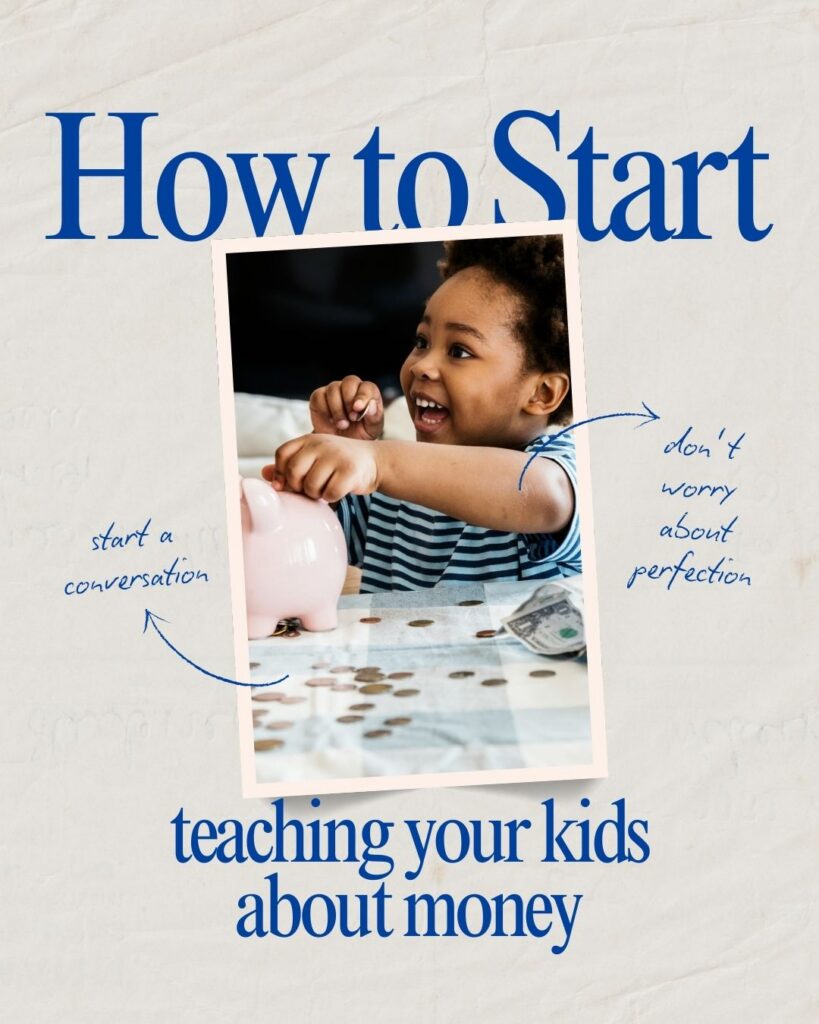
Most parents want to teach their kids about money. The sticking point isn’t motivation — it’s timing.
Should you explain credit cards to a nine-year-old? Is a four-year-old too young to understand saving? What do you do if your twelve-year-old still thinks money comes from a machine at the wall? These questions aren’t trivial. Teaching the right concept at the wrong age doesn’t just fail to land — it can make kids feel overwhelmed, patronized, or checked out before they’ve really started.
This guide gives you a clear, stage-by-stage roadmap to teaching financial literacy for kids by age: what to teach at each age, the mindset behind it, and the activities that make it stick. Each stage builds on the one before it. None of them require apps, courses, or financial expertise on your part.
And if you’re reading this with a twelve-year-old who’s never held their own money? There’s a section at the end for you too.
Why Age-Appropriate Money Education Matters
There’s a meaningful difference between teaching a concept and teaching it to a brain that’s ready for it.
A five-year-old can understand that a cookie costs something and that choosing the cookie means no more money for something else. She cannot meaningfully grasp compound interest, opportunity cost, or the difference between a Roth IRA and a traditional IRA. Trying to teach her those things doesn’t accelerate her financial education — it just makes money feel confusing and abstract at an age when it should feel concrete and manageable.
The same applies in the other direction. A sixteen-year-old who’s never been given responsibility for real money decisions isn’t going to develop financial competence through a lecture. He needs to handle real money, make real choices, and experience real consequences.
Age-appropriate teaching isn’t about being strict with a curriculum. It’s about matching concepts to the developmental stage where they actually stick. Each stage below represents a window where certain ideas become genuinely usable — not just something a child can repeat back, but something they can internalize and act on.
If you’re looking for the full picture of when to start and how early is too early, the What Age Should Kids Start Learning About Money guide covers that in depth.
Ages 3–5: The Foundation (Money Is Real, Choices Have Consequences)
Ages 3–5 — Money is real, and every choice costs something else.
Preschool-age kids are at the stage where everything abstract needs to become physical before it means anything. Money is no different. The goal here isn’t to teach them to count coins perfectly — it’s to make money real, tangible, and connected to the world they already live in.
Two ideas are worth planting at this age. First, money is something people earn by doing things — it doesn’t appear magically. Second, choosing one thing means not having another. That second idea, introduced simply and consistently, is the seed of every budgeting decision they’ll ever make.
Keep it physical. Bills and coins, not an app. A piggy bank they can shake, not a number on a screen. Abstract concepts need tangible anchors at this age, and physical money provides them. This is key for teaching financial literacy for kids by age in this age range.
Mindset concept: “Money is real, and when I spend it on one thing, I can’t spend it on something else.”
Activities: Let them handle real coins — identify them, count them, hand them over at a checkout. At the store, offer two choices within a small budget and let them pick. When they choose, name it out loud: “You chose the crackers, so we’re putting the cookies back.” Simple, consistent, repeated.
Ages 6–8: Earning and Saving Basics
Ages 6–8 — I earn money by working, and saving comes before spending.
At six, most kids are ready to connect effort to income in a real and direct way. Not hypothetically — actually. Give them tasks that pay, let them hold the money they earned, and let them spend it (or not) on their own terms.
The other idea to establish in this window is that saving comes before spending, not after. The typical adult approach — spend what you need, save whatever’s left — is exactly backwards, and it’s worth reversing the order early before it becomes habit.
The three-jar system (one for spending, one for saving, one for giving) works well at this age because it’s visual and physical. Kids can see their saving jar growing. That visibility creates a feedback loop that willpower alone never does.
Mindset concept: “I earn money by doing real work, and I put money in my saving jar before I spend anything.”
Activities: Build a small paid-task list — three or four things with a dollar amount each. When your child completes one, pay them immediately and let them split the money between their jars. Give them a savings goal for something they actually want, and help them track how far away it is.
The Best Money Lessons for Kids Under 10 article covers this age range in detail, including specific belief statements and activities for each core concept.
Ages 9–11: Budgeting, Goals, and Delayed Gratification
Ages 9–11 — I can plan ahead with money and make it work toward something I want.
By nine or ten, kids are ready to move from reactive money management (earn it, decide what to do with it) to proactive planning (set a goal, figure out how to get there). This is when simple budgeting becomes meaningful rather than abstract.
The concept to introduce here is the savings timeline: if you want something that costs $40, and you save $5 a week, you’ll have it in eight weeks. That math is accessible, and it makes time and money connect in a concrete, usable way.
This is also a good age to introduce comparison shopping — not as a financial lecture, but as a practical skill. Before buying something, look at two or three options and talk through the trade-offs. Is the cheaper version worth it? Is the more expensive one actually better, or just more expensive?
Mindset concept: “I can set a money goal, figure out how long it will take, and make a plan to get there.”
Activities: Give your child a specific spending category to budget — birthday gifts for the year, school supplies, or a hobby they’re into. Let them allocate a set amount and decide how to spend it across the year. Separately, help them work out the math on a savings goal: price divided by weekly savings equals weeks to goal.
For deeper coverage of the delayed gratification research and how to build that muscle, see Teaching Kids Delayed Gratification.
Ages 12–14: Income Streams, Banking, and Wants vs. Needs
Ages 12–14 — I manage money in real systems, and I can start generating my own.
Middle school is where the training wheels should start coming off. At twelve or thirteen, kids are old enough to have a real bank account, manage a slightly more complex budget, and start thinking about how to earn money beyond the household.
The banking piece matters here for a specific reason: digital money. Up to this point, physical cash makes money feel real. But at twelve, kids are increasingly moving through a digital world — and an abstract number in an account can feel very different from a jar of coins. Opening a real checking or savings account, making actual deposits, and watching a balance connect the physical to the digital.
This is also the right age to revisit needs vs. wants — but at a higher level of nuance than the preschool version. At twelve, the conversation is less “food is a need, toys are a want” and more “how do you decide what’s worth spending money on when you have competing priorities and limited resources?” That’s a question adults wrestle with constantly, and starting to develop a framework for it here pays real dividends.
Mindset concept: “I manage money in real accounts, I can generate my own income, and I decide what’s worth spending on.”
Activities: Open a basic checking or savings account together — let your child make the first deposit. At the same time, identify one way they can earn money outside the house: lawn mowing, tutoring a younger student, selling things they no longer need, or offering a service in the neighborhood. Help them set up something simple and actually do it.
When they’re ready for their first account, When Kids Should Get Their First Bank Account covers what to look for and when the timing makes sense.
Ages 15–18: Credit, Investing, and Adult Money Skills
Ages 15–18 — I understand how money grows and shrinks over time — and I manage it like an adult.
This is the stage where financial education becomes genuinely urgent. A seventeen-year-old is one year away from making independent financial decisions: taking on a car loan, signing a lease, opening a credit card, choosing a college and its price tag. The window for structured learning is closing.
Three concepts matter most here, and all three are underrepresented in most families’ financial conversations.
Credit. Most teens enter adulthood with no credit history and no understanding of how credit scores work — which means they start their adult financial lives at a disadvantage. Adding your teenager as an authorized user on a credit card you already use well gives them a credit history without the risk. Pair it with a direct, jargon-free explanation of how credit scores are calculated.
Investing. Compound interest is one of those concepts that sounds boring until you show someone what $1,000 invested at fifteen is worth at sixty-five versus twenty-five. A custodial brokerage account — where they put in a small amount and watch it move with a real index fund — makes this tangible in a way no spreadsheet example can.
Adult money mechanics. Sit down with a recent pay stub and walk through it together. Show them what FICA is, what a 401(k) contribution looks like, what gross versus net income means. This one conversation prevents years of confusion and frustration.
Mindset concept: “I understand how credit works, how money grows over time, and what a budget looks like when I’m paying my own bills.”
Activities: Open a custodial investment account and let them put in even $25 to start — the point is the experience, not the amount. Walk through a pay stub together. Build a mock monthly budget using realistic numbers for rent, groceries, phone, and utilities in your area. The exercise of planning for real expenses makes the abstract future feel concrete.
Signs Your Child Is Ready for the Next Level
The age ranges above are guidelines, not hard cutoffs. Some kids are ready to move ahead earlier; others need more time in a given stage. A few things to watch for that signal readiness:
They’re asking questions you didn’t prompt. “How much does our house cost?” “Why does that brand cost more?” “Can I earn money doing that?” Curiosity about money is the clearest sign they’re ready for more.
They’re making saving decisions on their own. When a kid starts voluntarily holding back money for something rather than spending everything available, the saving habit is taking root.
They’re comparing options before buying. Comparison shopping — even informally — is a sign that the “choices have trade-offs” concept has genuinely landed.
They push back on decisions. A child who asks “why are we buying that one and not the cheaper one?” is engaging with money critically. That’s worth encouraging, even when the timing is inconvenient.
What Happens If You Start Late?
If your child is eleven and you’ve never given them an allowance, or thirteen and this is the first time money has been discussed in any structured way, the honest answer is: you’re behind, but not by much, and it’s entirely fixable.
The age-7 research describes averages — when habits tend to form in kids who are exposed to money concepts early. It doesn’t describe a door that closes. Financial habits can be built at any age. Adults change their financial behavior all the time, and kids are considerably more flexible than adults.
The practical approach for catching up is to compress without skipping. If your ten-year-old has had no money experience, start with the Ages 6–8 framework — the three jars, the paid task list, the savings goal. Within a few months of consistent practice, they’ll be ready for the 9–11 concepts. You won’t need years per stage to accelerate through the earlier ones.
The age where starting late genuinely becomes urgent is around fourteen or fifteen. At that point, college financial decisions, first jobs, and potential credit cards are close enough that there’s real cost to not having built a foundation. If that’s where you are, start now — not next semester.
The How to Teach Kids About Money guide covers the full framework for building financial habits from scratch, regardless of your starting point.
Quick-Reference Chart: Financial Literacy For Kids by Age
Use this as a planning tool — pick the stage your child is in and start there:
| Ages | Key Mindset | Must-Teach Concept | Simple Activity |
| 3-5 | “Money is real and choices matter.” | Coins have value; one choice costs you another | Handle coins; two-choice store game |
| 6-8 | “I earn money and I save before I spend.” | Earning through effort; three-jar saving system | Paid chore list; split allowance into jars |
| 9-11 | “I can plan ahead with money.” | Simple budgets; savings goals with timelines | Category budget; savings goal math |
| 12-14 | “I manage money in real systems.” | Banking basics; micro-income; needs vs. wants | First bank account; small earning project |
| 15-18 | “I understand how money grows and shrinks.” | Credit, investing, taxes, adult budgeting | Custodial investment account; read a pay stub |
The goal of this roadmap isn’t to rush kids through stages or check boxes off a list. It’s to make sure that by the time your child is making independent financial decisions — and that day comes faster than it feels like it will — they have a framework that’s been years in the making rather than something assembled at the last minute.
For the lesson-by-lesson breakdown of the under-10 years, see Best Money Lessons for Kids Under 10. For the full philosophical foundation behind this approach, start with the How to Teach Kids About Money guide.