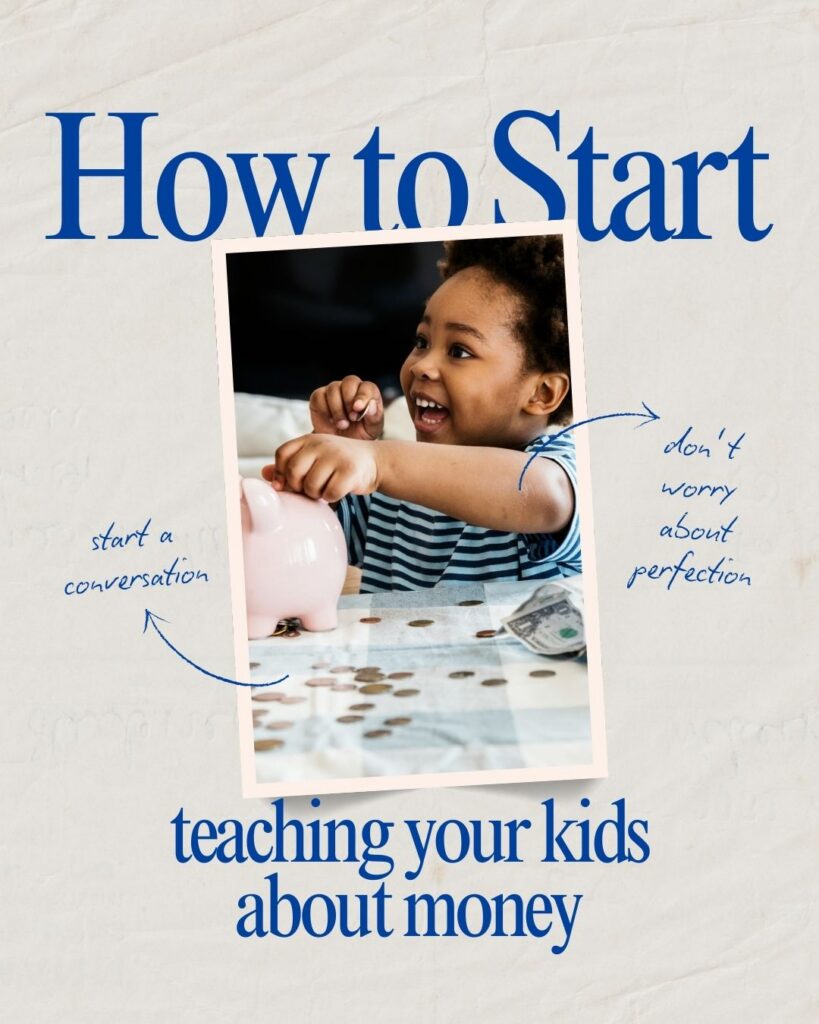
At some point, most parents realize they’ve been answering questions about money without actually teaching it.
“Why can’t you just get more money from the machine?” “Why do we have to leave? I want that toy.” “Can’t we just buy both??”
These moments pass. You distract them, move on, and tell yourself you’ll get to the money stuff later when they’re old enough to understand it. Money lessons for kids are never conveniently timed.
But here’s the issue: “later” isn’t when financial habits form. Research from the University of Cambridge found that money habits and attitudes are largely set by age 7. The window for shaping a strong financial identity isn’t high school — it’s right now, during the sticky, impressionable years before ten.
The good news is that none of this requires spreadsheets, investment accounts, or sit-down lectures. It requires small, consistent moments that help your child see themselves as someone who handles money with intention.
That’s what the lessons below are actually building.
Why Under 10 Is the Most Important Financial Window to Teach Money Lessons For Kids
Most parents think financial education is a teenager conversation — budgets when they’re driving, credit cards before college. The data pushes back on that pretty hard.
The Cambridge study found financial habits are largely in place by age 7. Not because kids that age are doing complex math, but because they’re forming beliefs: whether they can trust themselves with money, whether saving feels natural or spending feels automatic, whether money is something to manage or something to worry about. This is why money lessons for kids need to be taught early.
The goal before ten isn’t financial strategy. It’s financial identity — the quiet, mostly unconscious belief system that will drive every money decision they make for the rest of their lives.
Each of the seven lessons below comes with a belief statement: a single sentence your child can start to internalize as part of who they are. That’s the lesson underneath the activity. The activity is just the delivery mechanism.
For the full progression of concepts by age, the Financial Literacy for Kids by Age guide maps out the complete picture.
Lesson 1: Money Is Earned, Not Given
Belief statement: “I earn money by working and helping.”
Young kids often see money as something that just appears — from a wallet, an ATM, a birthday card. That model causes real problems later. The first correction is making the connection between effort and money explicit and real.
This doesn’t mean making kids work for every dollar, or turning childhood into a hustle operation. It means being deliberate about pointing out the connection. When your six-year-old helps carry in the grocery bags, acknowledge the contribution. When they take on something genuinely difficult beyond their normal day-to-day — raking leaves, helping a neighbor, completing a tough task — let them earn something real for it.
The earning itself matters less than the association: effort creates resources.
Try this: Put together a small “family job board” — three or four tasks with a dollar amount on each. Nothing elaborate: a sticky note on the fridge works. Make the connection explicit every single time: “You did that job, you earned that money.”
Lesson 2: Saving Is a Habit, Not a Sacrifice
Belief statement: “I am a saver.”
Most kids are taught to save because they want something specific. That framing works in the short term, but it positions saving as waiting — a temporary delay between wanting and getting. Once the goal is met, the habit evaporates.
The more durable lesson is that savers save because that’s who they are. Not because they’re disciplined, not because they’re waiting for a specific toy, but because putting money aside first is simply how they operate.
A clear jar works better than a piggy bank for this age because kids can see the money growing. Every time money comes in, a portion goes in the jar first — before any spending decisions. Frame it as the default: “This is just what we do.”
Try this: Start with a three-jar system: one for saving, one for spending, one for giving. When money comes in, split it together using actual coins. The physical act of handling money and making the decision cements the habit far more than any rule you could impose.
The Teaching Kids the Value of Saving guide goes deeper on building the saving identity — including what to do when kids want to raid their jars early.
Lesson 3: You Can’t Have Everything — And That’s a Good Thing
Belief statement: “I choose what to spend my money on.”
Every child will eventually stand in a store with $3 and a long list of things they want. That moment isn’t a problem. It’s a classroom.
The lesson isn’t deprivation — it’s ownership. Wealthy people don’t buy everything they want because they can; they buy what they decide to buy. Choosing one thing means not having another, and that’s not a punishment. That’s agency.
The framing that helps: “What do you want to choose?” Not “You can’t have that.” One small word shift that moves the whole dynamic from refusal to decision-making.
Try this: Before a store trip, give your child their spending money in cash. Walk through the store together and look at options before touching anything. Encourage comparison out loud: “If you get that, you won’t have enough for this one. Which one matters more to you?” Then let them decide — and don’t second-guess the choice.
For how this concept grows into more nuanced decision-making, see Teaching Kids Needs vs Wants.
Lesson 4: Waiting Makes Things Better (Delayed Gratification)
Belief statement: “Good things are worth waiting for.”
The famous Stanford marshmallow experiment offered young children a choice: one marshmallow now, or two if they waited 15 minutes. The kids who waited showed stronger outcomes across multiple measures years later. What researchers found was less about willpower and more about trust: the kids who waited believed the wait would be worth it.
For under-10 kids, this lesson is about building that same trust. Waiting needs to produce a better outcome reliably enough that it stops feeling like a trick and starts feeling like a strategy.
Try this: Tell your child you’ll match whatever they save by a specific date — if they save $5 by the end of the month, they get $10. This makes delayed gratification concrete: the wait produces something visible and real. Start with short time windows — a week, not six months — so the payoff comes fast enough to reinforce the lesson.
Lesson 5: Giving is part of the plan
Belief statement: “I give because I choose to, not because I’m told to.”
Generosity is a financial habit, not just a moral one. Kids who grow up treating giving as something external — an obligation, a requirement — often quietly detach from it as adults. Kids who grow up treating giving as part of their own money plan carry it forward.
The difference comes down to ownership. When giving feels chosen rather than imposed, it sticks. Ask your child who or what they want to help. Give them the options and let them pick. Let it feel like their decision — because it is.
Try this: Set up a third jar labeled “give.” When it accumulates, sit down together and ask your child to choose where it goes — a food pantry, an animal shelter, a friend who needs help. If possible, go together to make the donation in person. The physical act of handing over the money is the lesson.
Lesson 6: Money Is a Tool, Not a Goal
Belief statement: “Money is for doing things that matter to me.”
Children who grow up watching adults stress about money, chase money, or talk about money as the whole point of working often emerge with one of two beliefs: money is everything, or money is the cause of all problems. Neither is useful.
The healthier frame is that money is a tool. Like any tool, it’s useful for specific purposes. You don’t want more hammers for the sake of hammers — you want enough to build what you’re building.
This lesson is less about a single activity and more about the language you use around money at home. Connect spending to purpose. Talk about what money lets you do, not just what it costs.
Try this: When your child saves up for something they’ve wanted, make a small moment of it. Ask: “What does this let you do? What were you saving for?” Connect the money to the outcome. The purchase is just the mechanism — the point is what it makes possible.
Lesson 7: Mistakes With Money Are How You Learn
Belief statement: “When I mess up with money, I learn from it and I’m okay.”
Every parent has watched a child spend their allowance on something cheap and regret it almost immediately. The instinct is to rescue them — cover the gap, soften the sting, make it right.
Resist that instinct.
A child who spends $7 on a toy that breaks in an afternoon, then has nothing left for the book they actually wanted, has just paid $7 for a lesson no parent could manufacture. The sting is the education. Let it land.
Then — once the frustration has passed — ask three questions: What happened? Why do you think it happened? What would you do differently next time? No lecture. Just those three questions. That’s the whole sequence: decide, experience, reflect. Repeat it enough times before ten, and they’ll handle money differently as adults.
Try this: When a money mistake happens, wait until the feelings settle, then sit down and work through the three questions together. Keep it short. The goal isn’t to make them feel bad — it’s to turn the experience into something they can use.
How to Reinforce These Lessons Daily (Without Making It a Lecture)
The risk with financial education is turning it into a chore — or worse, a recurring lecture. Kids under 10 tune out repetitive moralizing fast. What works is making money conversations routine, brief, and connected to something real that’s already happening.
Let them handle cash. Physical money is more real to young kids than digital numbers on a screen. Let them count change at the register, hand over bills, and see what’s left. The tactile experience builds intuition.
Narrate your own decisions out loud. “I’m comparing these two because one lasts longer even though it costs more.” You don’t need to turn it into a lesson — just say the thought. Kids pick up more from watching you reason than from being taught at.
Use real moments, not hypotheticals. The grocery store, the birthday money, the broken impulse purchase — these are better classrooms than any book. When a real money situation arises, that’s the moment.
Keep it short. One point, one moment. A thirty-second observation about a spending decision is worth more than a thirty-minute sit-down session they’ll tune out by minute three.
For the full age-by-age roadmap of what concepts to introduce when, see How to Teach Kids About Money — it’s the complete foundation that all of these lessons plug into. The Allowance vs Chores guide is also useful for thinking about how to structure the earning side practically.
Quick Reference: All 7 Lessons at a Glance
Use this as a cheat sheet for planning activities or deciding which lesson to focus on next:
| Lesson | Belief Statement | Simple Activity |
| 1) Money is Earned | “I earn money by working.” | Family job board: 3-4 paid tasks with clear dollar amounts. |
| 2) Saving is a habit | “I am a saver.” | Three-jar split (save/spend/give) every time money comes in. |
| 3) You Can’t Have Everything | “I choose what to spend on.” | Cash-only store trip: choose before buying, compare options first. |
| 4) Waiting makes things better | “Good things are worth waiting for.” | Savings match: double their savings if they wait until a set date. |
| 5) Giving is part of the plan | “I give because I choose to.” | Give jar: child picks the recipient and makes the donation. |
| 6) Money is a tool | “Money is for things that matter to me.” | After a purchase: “What does this let you do?” Connect money to outcome. |
| 7) Mistakes are lessons | “When I mess up, I learn.” | Post-mistake debrief: What happened? Why? What next time? |
These seven lessons don’t need to be taught in order, and they don’t all need to happen this week. Introduce one, let it settle, and look for natural moments to reinforce it. By the time your child turns ten, these ideas won’t feel like lessons anymore — they’ll just feel like how your family thinks about money.